Our blog is dedicated to keeping you informed about not only real estate but life in the mountains of Northeast Georgia and Western North Carolina. It's a Good Life!


Nov. 26, 2018

Buyers: Don’t Be Surprised by Closing Costs!

Many homebuyers think that saving for their down payment is enough to buy the house of their dreams, but what about the closing costs that are required to obtain a mortgage?

By law, a homebuyer will receive a loan estimate from their lender 3 days after submitting their loan application and they should receive a closing disclosure 3 days before the scheduled closing on their home. The closing disclosure includes final details about the loan and the closing costs.

But what are closing costs anyway?

According to Trulia: “Closing costs are lender and third-party fees paid at the closing of a real estate transaction, and they can be financed as part of the deal or be paid upfront. They range from 2% to 5% of the purchase price of a home. (For those who buy a $150,000 home, for example, that would amount to between $3,000 and $7,500 in closing fees.)”

Keep in mind that if you are in the market for a home above this price range, your costs could be significantly greater.

As mentioned before, Closing costs are typically between 2% and 5% of your purchase price.

Trulia continues to give great advice, saying that: “…understanding and educating yourself about these costs before settlement day arrives might help you avoid any headaches at the end of the deal.”

Bottom Line

Speak with your lender and agent early and often to determine how much you’ll be responsible for at closing. Finding out that you’ll need to come up with thousands of dollars right before closing is not a surprise anyone is ever looking forward to.

Oct. 25, 2018

Tips for Winterizing Your Home

Oct. 16, 2018

Home Equity by the Numbers

As home prices have continued to rise across the country, so has home equity. If you're looking to sell your house and move up to your dream home, right now is a great time to use your equity to do so. Let's get together today to go over how much equity you have in your house right now!

Posted in For Buyers, For Sellers
Oct. 16, 2018

Baby Boomers are Downsizing, Are You Ready to Move?

For a while now baby boomers have been blamed for a portion of the housing market's current lack of housing inventory, but should they really be getting the blame?

Here's what some of the experts have to say on the subject:

Aaron Terrazas, Senior Economist at  Zillow, says that "Boomers are healthier and working longer than previous generations, which means they aren't yet ready to sell their homes."

According to study byRealtor.com, 85% of baby boomers indicated they were not planning to sell their homes.

It is true that baby boomers are healthier and are thus working and living longer, but are they also refusing to sell their homes?

Last month, Trulia looked at the housing situation of seniors (aged 65+) today compared to that of a decade ago.Trulia's study revealed that:

"Although seniors appear to be delaying downsizing until later in life, as a group, households 65 and over are still downsizing at roughly the same rate as in years past."

Trulia also explains that,

"5.5% of households 65 and over moved, pretty evenly split between moves to single family (2.7%) and multifamily (2.4%) homes. In 2005, these percentages were virtually the same, with 5.5% of senior households moving, including 2.5% into single family and 2.5% into multifamily homes."

So, if these percentages are the same, what is the challenge?

Recent reports tell us that the older population grew from 3 million in 1900 to 47.8 million in 2017.

In addition, the Census recently revised the numbers from their National Population Projections:

"The aging of baby boomers means that within just a couple decades, older people are projected to outnumber children for the first time in U.S. history... By 2035, there will be 78.0 million people 65 years and older compared to 76.7 million under the age of 18."

Bottom Line

If you are a baby boomer who is not sure whether you should downsize or move to a warmer climate (other people are doing it, why not you?), let's get together so we can help you evaluate your options today!

Posted in For Buyers, For Sellers
Sept. 28, 2018

Should I Buy Now? Or Wait Until Next Year?

Some Highlights:

  • The cost of waiting to buy is defined as the additional funds it would take to buy a home if prices & interest rates were to increase over a period of time.
  • Freddie Mac predicts interest rates to rise to 5.2% by the third quarter of 2019.
  • CoreLogic predicts home prices to appreciate by 5.1% over the next 12 months.
  • If you are ready and willing to buy your dream home, find out if you are able to!
Sept. 28, 2018

Is There a Shift Happening in the Real Estate Market?

Housing inventory is up year-over-year for the first time in three years which means that home price appreciation will likely begin to slow. If you're looking to buy or sell a home, now is still a great time! Let's get together today to go over what this shift in the market means for you.

Posted in For Buyers, For Sellers
Sept. 24, 2018

Rising Home Prices Help Build Family Wealth

As home prices continue to appreciate, many potential buyers and sellers aren't sure what it really means for them. It's important to understand, however, that rising prices also means rising equity. If you're wondering what home price appreciation means for you, let's get together to discuss building your wealth today!

Posted in For Buyers, For Sellers
Sept. 24, 2018

How Much Has Your Home Increased in Value?

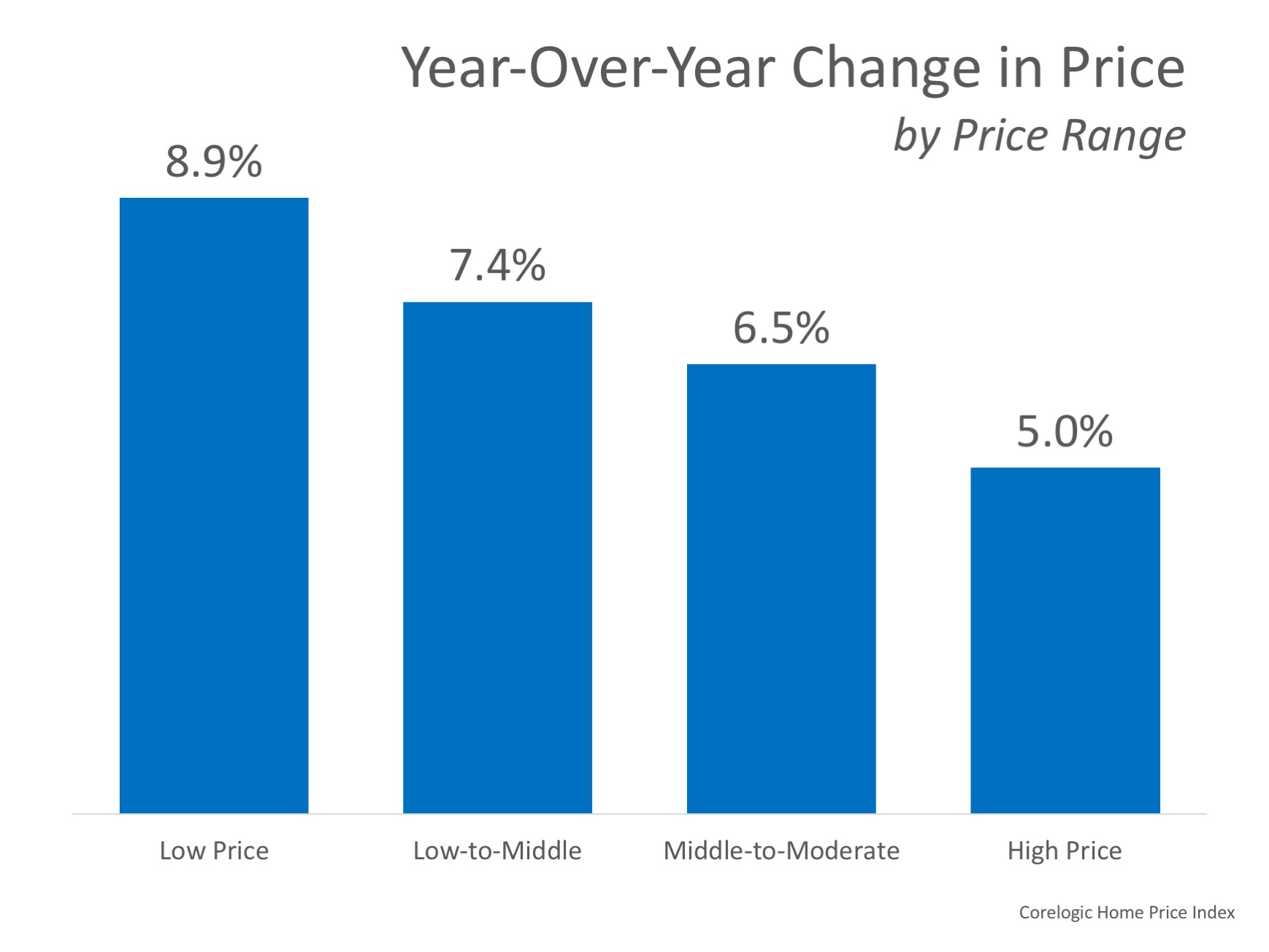
Home values have risen dramatically over the last twelve months. In CoreLogic’s most recent Home Price Index Report, they revealed that national home prices have increased by 6.2% year-over-year.

CoreLogic broke down appreciation even further into four price ranges, giving us a more detailed view than if we had simply looked at the year-over-year increases in national median home price. The chart below shows the four price ranges from the report, as well as each one’s year-over-year growth from July 2017 to July 2018 (the latest data available).

It is important to pay attention to how prices are changing in your local market. The location of your home is not the only factor which determines how much your home has appreciated over the course of the last year. Lower-priced homes have appreciated at greater rates than homes at the upper ends of the spectrum due to demand from first-time home buyers and baby boomers looking to downsize.

Bottom Line

If you are planning to list your home for sale in today’s market, let’s get together to go over exactly what’s going on in your area and your price range.

Posted in For Buyers, For Sellers
Sept. 21, 2018

5 Reasons to Sell Your House This Fall

Have you been thinking about putting your house on the market? What about moving-up to the house of your dreams? With supply and demand continuing to raise prices, now may be the perfect time! Let's get together to discuss why you should list your house for sale this fall!

Posted in For Sellers
Sept. 21, 2018

Is the Real Estate Market Finally Getting Back to Normal?

The housing market has been anything but normal for the last eleven years. In a normal real estate market, home prices appreciate 3.7% annually. Below, however, are the price swings since 2007 according to the latest Home Price Expectation Survey:

After the bubble burst in June 2007, values depreciated 6.1% annually until February 2012. From March 2012 to today, the market has been recovering with values appreciating 6.2% annually.

These wild swings in values were caused by abnormal ratios between the available supply of inventory and buyer demand in the market. In a normal market, there would be a 6-month supply of housing inventory.

When the market hit its peak in 2007, homeowners and builders were trying to take advantage of a market that was fueled by an "irrational exuberance."

Inventory levels grew to 7+ months. With that many homes available for sale, there weren’t enough buyers to satisfy the number of homeowners/builders trying to sell, so prices began to fall.

Then, foreclosures came to market. We eventually hit 11 months inventory which caused prices to crash until early 2012. By that time, inventory levels had fallen to 6.2 months and the market began its recovery.

Over the last five years, inventory levels have remained well below the 6-month supply needed for prices to continue to level off. As a result, home prices have increased over that time at percentages well above the appreciation levels seen in a more normal market.

That was the past. What about the future?

We currently have about 4.5-months inventory. This means prices should continue to appreciate at above-normal levels which most experts believe will happen for the next year. However, two things have just occurred that are pointing to the fact that we may be returning to a more normal market.

1. Listing Supply is Increasing

Both existing and new construction inventory is on the rise. The latest Existing Home Sales Report from the National Association of Realtors revealed that inventory has increased over the last two months after thirty-seven consecutive months of declining inventory. At the same time, building permits are also increasing which means more new construction is about to come to market.

2. Buyer Demand is Softening

Ivy Zelman, who is widely respected as an industry expert, reported in her latest "Z" Report:

"While we continue to expect a resumption of growth in resale transactions on the back of easing inventory in 2019 and 2020, our real-time view into the market through our Real Estate Broker Survey does suggest that buyers have grown more discerning of late and a level of “pause” has taken hold in many large housing markets.

Indicative of this, our broker contacts rated buyer demand at 69 on a 0- 100 scale, still above average but down from 74 last year and representing the largest year-over-year decline in the two-year history of our survey."

With supply increasing and demand waning, we may soon be back to a more normal real estate market. We will no longer be in a buyers’ market (like 2007-February 2012) or a sellers’ market (like March 2012- Today).

Prices won’t appreciate at the levels we’ve seen recently, nor will they depreciate. It will be a balanced market where prices remain steady, where buyers will be better able to afford a home, and where sellers will more easily be able to move-up or move-down to a home that better suits their current lifestyles.

Bottom Line
Returning to a normal market is a good thing. However, after the zaniness of the last eleven years, it might feel strange. If you are going 85 miles per hour on a road with a 60 MPH speed limit and you see a police car ahead, you’re going to slow down quickly. But, after going 85 MPH, 60 MPH will feel like you're crawling. It is the normal speed limit, yet, it will feel strange.

That’s what is about to happen in real estate. The housing market is not falling apart. We are just returning to a more normal market which, in the long run, will be much healthier for you whether you are a buyer or a seller.